
Vectors in Component Form – Outschool
Vectors in Component Form Lesson
I. The Basics
Vectors in component form consist of an “x” component, a “y” component, and sometimes a “z” component (if you’re working in 3 dimensions).
These components tell you how far to move in the x-direction, the y-direction, and sometimes the z-direction to get to the endpoint of your resultant vector.
For example:
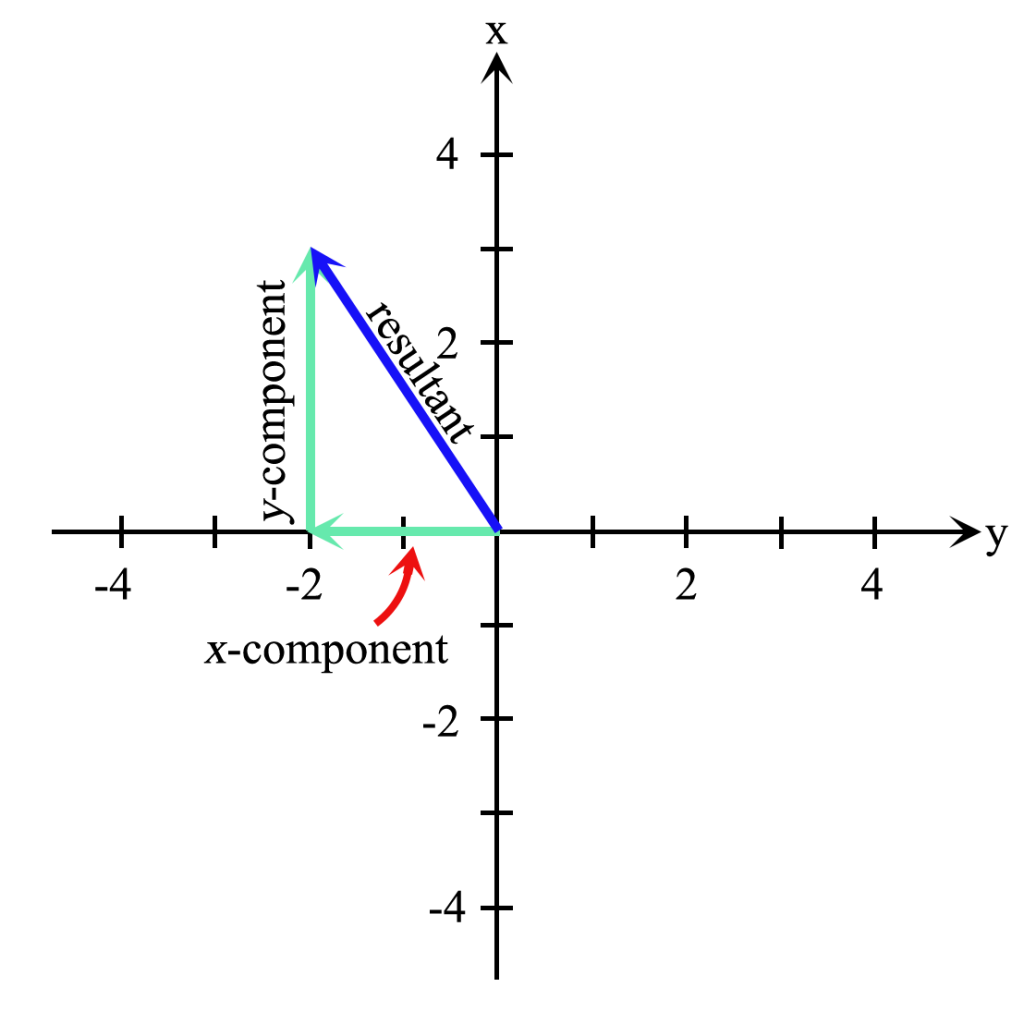
This vector moves -2 units in the x-direction and 3 units in the y-direction.
Vectors in component form can be expressed in different ways. One way is to write <x-component, y-component>.
In this notation, the vector in the graph above is <-2, 3>.
Another way to express component vectors is (x-component)i + (y-component)j.
The vector in the graph would look like -2i + 3j in this form.
II. Vector Operations
When adding or subtracting vectors, combine all of the x-components and all of the y-components.
Example 1: If u = <-1, 3> and v = <5, -4>, find u + v.
u + v → <-1, 3> + <5, -4> → <-1+5, 3+-4> → <4, -1>
When multiplying a vector by a number (called a scalar) , distribute the scalar to each component of the vector.
Example 2: If r = <7, 6>, find 3r.
3r → 3<7, 6> → <3⋅7, 3⋅6> → <21, 18>
Vector operations can be combined:
Example 3: If s= <5, -2> and t = <4, -6>, find 4s – t
Substitute the component forms for s and t :
4s – t → 4<5, -2> – <4, -6>
→ <20, -8> – <4, -6>
→ <16, -2>