
Natural Science Passage 3 – Outschool
Natural Science Passage 3 Quiz
NATURAL SCIENCE: This passage is adapted from Chapter 28 of Principles of Geology by Charles Lyell.
Quiz Summary
0 of 10 Questions completed
Questions:
Information
You have already completed the quiz before. Hence you can not start it again.
Quiz is loading…
You must sign in or sign up to start the quiz.
You must first complete the following:
Results
Results
0 of 10 Questions answered correctly
Your time:
Time has elapsed
You have reached 0 of 0 point(s), (0)
Earned Point(s): 0 of 0, (0)
0 Essay(s) Pending (Possible Point(s): 0)
Categories
- Not categorized 0%
- 1
- 2
- 3
- 4
- 5
- 6
- 7
- 8
- 9
- 10
- Current
- Review / Skip
- Answered
- Correct
- Incorrect
-
Question 1 of 10
1. Question
Calabria, 1783.—Of the numerous earthquakes which have occurred in different parts of the globe, during the last 100 years, that of Calabria, in 1783, is almost the only one of which the geologist can be said to have such a circumstantial account as to enable him fully to appreciate the changes which this cause is capable of producing in the lapse of ages. The shocks began in February, 1783, and lasted for nearly four years, to the end of 1786. Neither in duration, nor in violence, nor in the extent of territory moved, was this convulsion remarkable, when contrasted with many experienced in other countries, both during the last and present century; nor were the alterations which it occasioned in the relative level of hill and valley, land and sea, so great as those effected by some subterranean movements in South America, in later times. The importance of the earthquake in question arises from the circumstance, that Calabria is the only spot hitherto visited, both during and after the convulsions, by men possessing sufficient leisure, zeal, and scientific information, to enable them to collect and describe with accuracy the physical facts which throw light on geological question.
***
If the city of Oppido, in Calabria Ultra, be taken as a centre, and round that centre a circle be described, with a radius of twenty-two miles, this space will comprehend the surface of the country which suffered the greatest alteration, and where all the towns and villages were destroyed. The first shock, of February 5th, 1783, threw down, in two minutes, the greater part of the houses in all the cities, towns, and villages, from the western flanks of the Apennines in Calabria Ultra to Messina in Sicily, and convulsed the whole surface of the country. Another occurred on the 28th of March, with almost equal violence. The granitic chain which passes through Calabria from north to south, and attains the height of many thousand feet, was shaken but slightly by the first shock, but more rudely by some which followed.
***
Mr. Mallet, in his valuable essay on the Dynamics of Earthquakes, offers the following explanation of the fact to which Dolomieu has called attention. When a wave of elastic compression, of which he considers the earth-wave to consist, passes abruptly from a body having an extremely low elasticity, such as clay and gravel, into another like granite, whose elasticity is remarkably high, it changes not only its velocity but in part also its course, a portion being reflected and a portion refracted. The wave being thus sent back again produces a shock in the opposite direction, doing great damage to buildings on the surface by thus returning upon itself. At the same time, the shocks are at once eased when they get into the more elastic materials of the granitic mountains.
The surface of the country during the Calabrian earthquakes often heaved like the billows of a swelling sea, which produced a swimming in the head, like sea-sickness. It is particularly stated, in almost all the accounts, that just before each shock the clouds appeared motionless; and, although no explanation is offered of this phenomenon, it is obviously the same as that observed in a ship at sea when it pitches violently. The clouds seem arrested in their career as often as the vessel rises in a direction contrary to their course; so that the Calabrians must have experienced precisely the same motion on the land. Trees, supported by their trunks, sometimes bent during the shocks to the earth, and touched it with their tops. This is mentioned as a well-known fact by Dolomieu; and he assures us that he was always on his guard against the spirit of exaggeration in which the vulgar are ever ready to indulge when relating these wonderful occurrences.
***
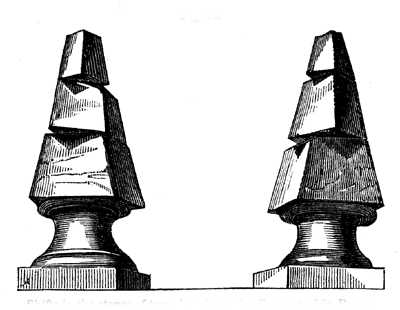
Fig. 75.
Shifts in the stones of two obelisks in the Convent of St Bruno.
The Academicians relate that in some of the cities of Calabria effects were produced seeming to indicate a whirling or vorticose movement. Thus, for example, two obelisks (fig. 75) placed at the extremities of a magnificent façade in the convent of S. Bruno, in a small town called Stefano del Bosco, were observed to have undergone a movement of a singular kind. The shock which agitated the building is described as having been horizontal and vorticose. The pedestal of each obelisk remained in its original place; but the separate stones above were turned partially round, and removed sometimes nine inches from their position without falling.
It has been suggested by Mr. Darwin that this kind of displacement may be due to a vibratory rather than a whirling motion; and more lately Mr. Mallet, in the paper already cited, has offered a very ingenious solution of the problem. He refers the twisting simply to an elastic wave, which has moved the pedestal forwards and back again, by an alternate horizontal motion within narrow limits, and he has succeeded in showing that a rectilinear movement in the ground may have sufficed to cause an incumbent body to turn partially round upon its bed, provided a certain relation exist between the position of the centre of gravity of the body and its centre of adherence.
According to the passage, which of the following makes the Calabria earthquake remarkable?
CorrectIncorrectHint
Question type: Direct from Text
Search the first paragraph.
-
Question 2 of 10
2. Question
Calabria, 1783.—Of the numerous earthquakes which have occurred in different parts of the globe, during the last 100 years, that of Calabria, in 1783, is almost the only one of which the geologist can be said to have such a circumstantial account as to enable him fully to appreciate the changes which this cause is capable of producing in the lapse of ages. The shocks began in February, 1783, and lasted for nearly four years, to the end of 1786. Neither in duration, nor in violence, nor in the extent of territory moved, was this convulsion remarkable, when contrasted with many experienced in other countries, both during the last and present century; nor were the alterations which it occasioned in the relative level of hill and valley, land and sea, so great as those effected by some subterranean movements in South America, in later times. The importance of the earthquake in question arises from the circumstance, that Calabria is the only spot hitherto visited, both during and after the convulsions, by men possessing sufficient leisure, zeal, and scientific information, to enable them to collect and describe with accuracy the physical facts which throw light on geological question.
***
(8) If the city of Oppido, in Calabria Ultra, be taken as a centre, and round that centre a circle be described, with a radius of twenty-two miles, this space will comprehend the surface of the country which suffered the greatest alteration, and where all the towns and villages were destroyed. The first shock, of February 5th, 1783, threw down, in two minutes, the greater part of the houses in all the cities, towns, and villages, from the western flanks of the Apennines in Calabria Ultra to Messina in Sicily, and convulsed the whole surface of the country. Another occurred on the 28th of March, with almost equal violence. The granitic chain which passes through Calabria from north to south, and attains the height of many thousand feet, was shaken but slightly by the first shock, but more rudely by some which followed.
***
(13) Mr. Mallet, in his valuable essay on the Dynamics of Earthquakes, offers the following explanation of the fact to which Dolomieu has called attention. When a wave of elastic compression, of which he considers the earth-wave to consist, passes abruptly from a body having an extremely low elasticity, such as clay and gravel, into another like granite, whose elasticity is remarkably high, it changes not only its velocity but in part also its course, a portion being reflected and a portion refracted. The wave being thus sent back again produces a shock in the opposite direction, doing great damage to buildings on the surface by thus returning upon itself. At the same time, the shocks are at once eased when they get into the more elastic materials of the granitic mountains.
(18) The surface of the country during the Calabrian earthquakes often heaved like the billows of a swelling sea, which produced a swimming in the head, like sea-sickness. It is particularly stated, in almost all the accounts, that just before each shock the clouds appeared motionless; and, although no explanation is offered of this phenomenon, it is obviously the same as that observed in a ship at sea when it pitches violently. The clouds seem arrested in their career as often as the vessel rises in a direction contrary to their course; so that the Calabrians must have experienced precisely the same motion on the land. Trees, supported by their trunks, sometimes bent during the shocks to the earth, and touched it with their tops. This is mentioned as a well-known fact by Dolomieu; and he assures us that he was always on his guard against the spirit of exaggeration in which the vulgar are ever ready to indulge when relating these wonderful occurrences.
***
(24) The Academicians relate that in some of the cities of Calabria effects were produced seeming to indicate a whirling or vorticose movement. Thus, for example, two obelisks placed at the extremities of a magnificent façade in the convent of S. Bruno, in a small town called Stefano del Bosco, were observed to have undergone a movement of a singular kind. The shock which agitated the building is described as having been horizontal and vorticose. The pedestal of each obelisk remained in its original place; but the separate stones above were turned partially round, and removed sometimes nine inches from their position without falling.
It has been suggested by Mr. Darwin that this kind of displacement may be due to a vibratory rather than a whirling motion; and more lately Mr. Mallet, in the paper already cited, has offered a very ingenious solution of the problem. He refers the twisting simply to an elastic wave, which has moved the pedestal forwards and back again, by an alternate horizontal motion within narrow limits, and he has succeeded in showing that a rectilinear movement in the ground may have sufficed to cause an incumbent body to turn partially round upon its bed, provided a certain relation exist between the position of the centre of gravity of the body and its centre of adherence.
According to Mr. Mallett, the earthquake wave of elastic compression (lines 13 and 14) changes in which of the following ways when passing from earth or clay into granite?
CorrectIncorrectHint
Question type: Direct from Text
Search the 3rd paragraph.
-
Question 3 of 10
3. Question
Calabria, 1783.—Of the numerous earthquakes which have occurred in different parts of the globe, during the last 100 years, that of Calabria, in 1783, is almost the only one of which the geologist can be said to have such a circumstantial account as to enable him fully to appreciate the changes which this cause is capable of producing in the lapse of ages. The shocks began in February, 1783, and lasted for nearly four years, to the end of 1786. Neither in duration, nor in violence, nor in the extent of territory moved, was this convulsion remarkable, when contrasted with many experienced in other countries, both during the last and present century; nor were the alterations which it occasioned in the relative level of hill and valley, land and sea, so great as those effected by some subterranean movements in South America, in later times. The importance of the earthquake in question arises from the circumstance, that Calabria is the only spot hitherto visited, both during and after the convulsions, by men possessing sufficient leisure, zeal, and scientific information, to enable them to collect and describe with accuracy the physical facts which throw light on geological question.
***
(8) If the city of Oppido, in Calabria Ultra, be taken as a centre, and round that centre a circle be described, with a radius of twenty-two miles, this space will comprehend the surface of the country which suffered the greatest alteration, and where all the towns and villages were destroyed. The first shock, of February 5th, 1783, threw down, in two minutes, the greater part of the houses in all the cities, towns, and villages, from the western flanks of the Apennines in Calabria Ultra to Messina in Sicily, and convulsed the whole surface of the country. Another occurred on the 28th of March, with almost equal violence. The granitic chain which passes through Calabria from north to south, and attains the height of many thousand feet, was shaken but slightly by the first shock, but more rudely by some which followed.
***
(13) Mr. Mallet, in his valuable essay on the Dynamics of Earthquakes, offers the following explanation of the fact to which Dolomieu has called attention. When a wave of elastic compression, of which he considers the earth-wave to consist, passes abruptly from a body having an extremely low elasticity, such as clay and gravel, into another like granite, whose elasticity is remarkably high, it changes not only its velocity but in part also its course, a portion being reflected and a portion refracted. The wave being thus sent back again produces a shock in the opposite direction, doing great damage to buildings on the surface by thus returning upon itself. At the same time, the shocks are at once eased when they get into the more elastic materials of the granitic mountains.
(18) The surface of the country during the Calabrian earthquakes often heaved like the billows of a swelling sea, which produced a swimming in the head, like sea-sickness. It is particularly stated, in almost all the accounts, that just before each shock the clouds appeared motionless; and, although no explanation is offered of this phenomenon, it is obviously the same as that observed in a ship at sea when it pitches violently. The clouds seem arrested in their career as often as the vessel rises in a direction contrary to their course; so that the Calabrians must have experienced precisely the same motion on the land. Trees, supported by their trunks, sometimes bent during the shocks to the earth, and touched it with their tops. This is mentioned as a well-known fact by Dolomieu; and he assures us that he was always on his guard against the spirit of exaggeration in which the vulgar are ever ready to indulge when relating these wonderful occurrences.
***
(24) The Academicians relate that in some of the cities of Calabria effects were produced seeming to indicate a whirling or vorticose movement. Thus, for example, two obelisks placed at the extremities of a magnificent façade in the convent of S. Bruno, in a small town called Stefano del Bosco, were observed to have undergone a movement of a singular kind. The shock which agitated the building is described as having been horizontal and vorticose. The pedestal of each obelisk remained in its original place; but the separate stones above were turned partially round, and removed sometimes nine inches from their position without falling.
It has been suggested by Mr. Darwin that this kind of displacement may be due to a vibratory rather than a whirling motion; and more lately Mr. Mallet, in the paper already cited, has offered a very ingenious solution of the problem. He refers the twisting simply to an elastic wave, which has moved the pedestal forwards and back again, by an alternate horizontal motion within narrow limits, and he has succeeded in showing that a rectilinear movement in the ground may have sufficed to cause an incumbent body to turn partially round upon its bed, provided a certain relation exist between the position of the centre of gravity of the body and its centre of adherence.
Which of the following is NOT associated with the Calabria earthquake?
CorrectIncorrectHint
Question type: Everything EXCEPT
Three of the answers will be supporting in the text; the other will not.
-
Question 4 of 10
4. Question
Calabria, 1783.—Of the numerous earthquakes which have occurred in different parts of the globe, during the last 100 years, that of Calabria, in 1783, is almost the only one of which the geologist can be said to have such a circumstantial account as to enable him fully to appreciate the changes which this cause is capable of producing in the lapse of ages. The shocks began in February, 1783, and lasted for nearly four years, to the end of 1786. Neither in duration, nor in violence, nor in the extent of territory moved, was this convulsion remarkable, when contrasted with many experienced in other countries, both during the last and present century; nor were the alterations which it occasioned in the relative level of hill and valley, land and sea, so great as those effected by some subterranean movements in South America, in later times. The importance of the earthquake in question arises from the circumstance, that Calabria is the only spot hitherto visited, both during and after the convulsions, by men possessing sufficient leisure, zeal, and scientific information, to enable them to collect and describe with accuracy the physical facts which throw light on geological question.
***
(8) If the city of Oppido, in Calabria Ultra, be taken as a centre, and round that centre a circle be described, with a radius of twenty-two miles, this space will comprehend the surface of the country which suffered the greatest alteration, and where all the towns and villages were destroyed. The first shock, of February 5th, 1783, threw down, in two minutes, the greater part of the houses in all the cities, towns, and villages, from the western flanks of the Apennines in Calabria Ultra to Messina in Sicily, and convulsed the whole surface of the country. Another occurred on the 28th of March, with almost equal violence. The granitic chain which passes through Calabria from north to south, and attains the height of many thousand feet, was shaken but slightly by the first shock, but more rudely by some which followed.
***
(13) Mr. Mallet, in his valuable essay on the Dynamics of Earthquakes, offers the following explanation of the fact to which Dolomieu has called attention. When a wave of elastic compression, of which he considers the earth-wave to consist, passes abruptly from a body having an extremely low elasticity, such as clay and gravel, into another like granite, whose elasticity is remarkably high, it changes not only its velocity but in part also its course, a portion being reflected and a portion refracted. The wave being thus sent back again produces a shock in the opposite direction, doing great damage to buildings on the surface by thus returning upon itself. At the same time, the shocks are at once eased when they get into the more elastic materials of the granitic mountains.
(18) The surface of the country during the Calabrian earthquakes often heaved like the billows of a swelling sea, which produced a swimming in the head, like sea-sickness. It is particularly stated, in almost all the accounts, that just before each shock the clouds appeared motionless; and, although no explanation is offered of this phenomenon, it is obviously the same as that observed in a ship at sea when it pitches violently. The clouds seem arrested in their career as often as the vessel rises in a direction contrary to their course; so that the Calabrians must have experienced precisely the same motion on the land. Trees, supported by their trunks, sometimes bent during the shocks to the earth, and touched it with their tops. This is mentioned as a well-known fact by Dolomieu; and he assures us that he was always on his guard against the spirit of exaggeration in which the vulgar are ever ready to indulge when relating these wonderful occurrences.
***
(24) The Academicians relate that in some of the cities of Calabria effects were produced seeming to indicate a whirling or vorticose movement. Thus, for example, two obelisks placed at the extremities of a magnificent façade in the convent of S. Bruno, in a small town called Stefano del Bosco, were observed to have undergone a movement of a singular kind. The shock which agitated the building is described as having been horizontal and vorticose. The pedestal of each obelisk remained in its original place; but the separate stones above were turned partially round, and removed sometimes nine inches from their position without falling.
It has been suggested by Mr. Darwin that this kind of displacement may be due to a vibratory rather than a whirling motion; and more lately Mr. Mallet, in the paper already cited, has offered a very ingenious solution of the problem. He refers the twisting simply to an elastic wave, which has moved the pedestal forwards and back again, by an alternate horizontal motion within narrow limits, and he has succeeded in showing that a rectilinear movement in the ground may have sufficed to cause an incumbent body to turn partially round upon its bed, provided a certain relation exist between the position of the centre of gravity of the body and its centre of adherence.
It can be inferred from the passage that Dolomieu was:
CorrectIncorrectHint
Question type: Inference
Search the 3rd and 4th paragraphs for text referring to Dolomieu.
-
Question 5 of 10
5. Question
Calabria, 1783.—Of the numerous earthquakes which have occurred in different parts of the globe, during the last 100 years, that of Calabria, in 1783, is almost the only one of which the geologist can be said to have such a circumstantial account as to enable him fully to appreciate the changes which this cause is capable of producing in the lapse of ages. The shocks began in February, 1783, and lasted for nearly four years, to the end of 1786. Neither in duration, nor in violence, nor in the extent of territory moved, was this convulsion remarkable, when contrasted with many experienced in other countries, both during the last and present century; nor were the alterations which it occasioned in the relative level of hill and valley, land and sea, so great as those effected by some subterranean movements in South America, in later times. The importance of the earthquake in question arises from the circumstance, that Calabria is the only spot hitherto visited, both during and after the convulsions, by men possessing sufficient leisure, zeal, and scientific information, to enable them to collect and describe with accuracy the physical facts which throw light on geological question.
***
(8) If the city of Oppido, in Calabria Ultra, be taken as a centre, and round that centre a circle be described, with a radius of twenty-two miles, this space will comprehend the surface of the country which suffered the greatest alteration, and where all the towns and villages were destroyed. The first shock, of February 5th, 1783, threw down, in two minutes, the greater part of the houses in all the cities, towns, and villages, from the western flanks of the Apennines in Calabria Ultra to Messina in Sicily, and convulsed the whole surface of the country. Another occurred on the 28th of March, with almost equal violence. The granitic chain which passes through Calabria from north to south, and attains the height of many thousand feet, was shaken but slightly by the first shock, but more rudely by some which followed.
***
(13) Mr. Mallet, in his valuable essay on the Dynamics of Earthquakes, offers the following explanation of the fact to which Dolomieu has called attention. When a wave of elastic compression, of which he considers the earth-wave to consist, passes abruptly from a body having an extremely low elasticity, such as clay and gravel, into another like granite, whose elasticity is remarkably high, it changes not only its velocity but in part also its course, a portion being reflected and a portion refracted. The wave being thus sent back again produces a shock in the opposite direction, doing great damage to buildings on the surface by thus returning upon itself. At the same time, the shocks are at once eased when they get into the more elastic materials of the granitic mountains.
(18) The surface of the country during the Calabrian earthquakes often heaved like the billows of a swelling sea, which produced a swimming in the head, like sea-sickness. It is particularly stated, in almost all the accounts, that just before each shock the clouds appeared motionless; and, although no explanation is offered of this phenomenon, it is obviously the same as that observed in a ship at sea when it pitches violently. The clouds seem arrested in their career as often as the vessel rises in a direction contrary to their course; so that the Calabrians must have experienced precisely the same motion on the land. Trees, supported by their trunks, sometimes bent during the shocks to the earth, and touched it with their tops. This is mentioned as a well-known fact by Dolomieu; and he assures us that he was always on his guard against the spirit of exaggeration in which the vulgar are ever ready to indulge when relating these wonderful occurrences.
***
(24) The Academicians relate that in some of the cities of Calabria effects were produced seeming to indicate a whirling or vorticose movement. Thus, for example, two obelisks placed at the extremities of a magnificent façade in the convent of S. Bruno, in a small town called Stefano del Bosco, were observed to have undergone a movement of a singular kind. The shock which agitated the building is described as having been horizontal and vorticose. The pedestal of each obelisk remained in its original place; but the separate stones above were turned partially round, and removed sometimes nine inches from their position without falling.
It has been suggested by Mr. Darwin that this kind of displacement may be due to a vibratory rather than a whirling motion; and more lately Mr. Mallet, in the paper already cited, has offered a very ingenious solution of the problem. He refers the twisting simply to an elastic wave, which has moved the pedestal forwards and back again, by an alternate horizontal motion within narrow limits, and he has succeeded in showing that a rectilinear movement in the ground may have sufficed to cause an incumbent body to turn partially round upon its bed, provided a certain relation exist between the position of the centre of gravity of the body and its centre of adherence.
Which of the following is given as the most likely explanation for the twisting of the obelisks in the convent of St. Bruno?
CorrectIncorrectHint
Question type: Direct from Text
Search the 5th and 6th paragraphs.
-
Question 6 of 10
6. Question
Calabria, 1783.—Of the numerous earthquakes which have occurred in different parts of the globe, during the last 100 years, that of Calabria, in 1783, is almost the only one of which the geologist can be said to have such a circumstantial account as to enable him fully to appreciate the changes which this cause is capable of producing in the lapse of ages. The shocks began in February, 1783, and lasted for nearly four years, to the end of 1786. Neither in duration, nor in violence, nor in the extent of territory moved, was this convulsion remarkable, when contrasted with many experienced in other countries, both during the last and present century; nor were the alterations which it occasioned in the relative level of hill and valley, land and sea, so great as those effected by some subterranean movements in South America, in later times. The importance of the earthquake in question arises from the circumstance, that Calabria is the only spot hitherto visited, both during and after the convulsions, by men possessing sufficient leisure, zeal, and scientific information, to enable them to collect and describe with accuracy the physical facts which throw light on geological question.
***
(8) If the city of Oppido, in Calabria Ultra, be taken as a centre, and round that centre a circle be described, with a radius of twenty-two miles, this space will comprehend the surface of the country which suffered the greatest alteration, and where all the towns and villages were destroyed. The first shock, of February 5th, 1783, threw down, in two minutes, the greater part of the houses in all the cities, towns, and villages, from the western flanks of the Apennines in Calabria Ultra to Messina in Sicily, and convulsed the whole surface of the country. Another occurred on the 28th of March, with almost equal violence. The granitic chain which passes through Calabria from north to south, and attains the height of many thousand feet, was shaken but slightly by the first shock, but more rudely by some which followed.
***
(13) Mr. Mallet, in his valuable essay on the Dynamics of Earthquakes, offers the following explanation of the fact to which Dolomieu has called attention. When a wave of elastic compression, of which he considers the earth-wave to consist, passes abruptly from a body having an extremely low elasticity, such as clay and gravel, into another like granite, whose elasticity is remarkably high, it changes not only its velocity but in part also its course, a portion being reflected and a portion refracted. The wave being thus sent back again produces a shock in the opposite direction, doing great damage to buildings on the surface by thus returning upon itself. At the same time, the shocks are at once eased when they get into the more elastic materials of the granitic mountains.
(18) The surface of the country during the Calabrian earthquakes often heaved like the billows of a swelling sea, which produced a swimming in the head, like sea-sickness. It is particularly stated, in almost all the accounts, that just before each shock the clouds appeared motionless; and, although no explanation is offered of this phenomenon, it is obviously the same as that observed in a ship at sea when it pitches violently. The clouds seem arrested in their career as often as the vessel rises in a direction contrary to their course; so that the Calabrians must have experienced precisely the same motion on the land. Trees, supported by their trunks, sometimes bent during the shocks to the earth, and touched it with their tops. This is mentioned as a well-known fact by Dolomieu; and he assures us that he was always on his guard against the spirit of exaggeration in which the vulgar are ever ready to indulge when relating these wonderful occurrences.
***
(24) The Academicians relate that in some of the cities of Calabria effects were produced seeming to indicate a whirling or vorticose movement. Thus, for example, two obelisks placed at the extremities of a magnificent façade in the convent of S. Bruno, in a small town called Stefano del Bosco, were observed to have undergone a movement of a singular kind. The shock which agitated the building is described as having been horizontal and vorticose. The pedestal of each obelisk remained in its original place; but the separate stones above were turned partially round, and removed sometimes nine inches from their position without falling.
It has been suggested by Mr. Darwin that this kind of displacement may be due to a vibratory rather than a whirling motion; and more lately Mr. Mallet, in the paper already cited, has offered a very ingenious solution of the problem. He refers the twisting simply to an elastic wave, which has moved the pedestal forwards and back again, by an alternate horizontal motion within narrow limits, and he has succeeded in showing that a rectilinear movement in the ground may have sufficed to cause an incumbent body to turn partially round upon its bed, provided a certain relation exist between the position of the centre of gravity of the body and its centre of adherence.
Which of the following scientists demonstrated that small rectilinear motions can produce a rotating effect?
CorrectIncorrectHint
Question type: Direct from Text
Search the 6th paragraph.
-
Question 7 of 10
7. Question
Calabria, 1783.—Of the numerous earthquakes which have occurred in different parts of the globe, during the last 100 years, that of Calabria, in 1783, is almost the only one of which the geologist can be said to have such a circumstantial account as to enable him fully to appreciate the changes which this cause is capable of producing in the lapse of ages. The shocks began in February, 1783, and lasted for nearly four years, to the end of 1786. Neither in duration, nor in violence, nor in the extent of territory moved, was this convulsion remarkable, when contrasted with many experienced in other countries, both during the last and present century; nor were the alterations which it occasioned in the relative level of hill and valley, land and sea, so great as those effected by some subterranean movements in South America, in later times. The importance of the earthquake in question arises from the circumstance, that Calabria is the only spot hitherto visited, both during and after the convulsions, by men possessing sufficient leisure, zeal, and scientific information, to enable them to collect and describe with accuracy the physical facts which throw light on geological question.
***
(8) If the city of Oppido, in Calabria Ultra, be taken as a centre, and round that centre a circle be described, with a radius of twenty-two miles, this space will comprehend the surface of the country which suffered the greatest alteration, and where all the towns and villages were destroyed. The first shock, of February 5th, 1783, threw down, in two minutes, the greater part of the houses in all the cities, towns, and villages, from the western flanks of the Apennines in Calabria Ultra to Messina in Sicily, and convulsed the whole surface of the country. Another occurred on the 28th of March, with almost equal violence. The granitic chain which passes through Calabria from north to south, and attains the height of many thousand feet, was shaken but slightly by the first shock, but more rudely by some which followed.
***
(13) Mr. Mallet, in his valuable essay on the Dynamics of Earthquakes, offers the following explanation of the fact to which Dolomieu has called attention. When a wave of elastic compression, of which he considers the earth-wave to consist, passes abruptly from a body having an extremely low elasticity, such as clay and gravel, into another like granite, whose elasticity is remarkably high, it changes not only its velocity but in part also its course, a portion being reflected and a portion refracted. The wave being thus sent back again produces a shock in the opposite direction, doing great damage to buildings on the surface by thus returning upon itself. At the same time, the shocks are at once eased when they get into the more elastic materials of the granitic mountains.
(18) The surface of the country during the Calabrian earthquakes often heaved like the billows of a swelling sea, which produced a swimming in the head, like sea-sickness. It is particularly stated, in almost all the accounts, that just before each shock the clouds appeared motionless; and, although no explanation is offered of this phenomenon, it is obviously the same as that observed in a ship at sea when it pitches violently. The clouds seem arrested in their career as often as the vessel rises in a direction contrary to their course; so that the Calabrians must have experienced precisely the same motion on the land. Trees, supported by their trunks, sometimes bent during the shocks to the earth, and touched it with their tops. This is mentioned as a well-known fact by Dolomieu; and he assures us that he was always on his guard against the spirit of exaggeration in which the vulgar are ever ready to indulge when relating these wonderful occurrences.
***
(24) The Academicians relate that in some of the cities of Calabria effects were produced seeming to indicate a whirling or vorticose movement. Thus, for example, two obelisks placed at the extremities of a magnificent façade in the convent of S. Bruno, in a small town called Stefano del Bosco, were observed to have undergone a movement of a singular kind. The shock which agitated the building is described as having been horizontal and vorticose. The pedestal of each obelisk remained in its original place; but the separate stones above were turned partially round, and removed sometimes nine inches from their position without falling.
It has been suggested by Mr. Darwin that this kind of displacement may be due to a vibratory rather than a whirling motion; and more lately Mr. Mallet, in the paper already cited, has offered a very ingenious solution of the problem. He refers the twisting simply to an elastic wave, which has moved the pedestal forwards and back again, by an alternate horizontal motion within narrow limits, and he has succeeded in showing that a rectilinear movement in the ground may have sufficed to cause an incumbent body to turn partially round upon its bed, provided a certain relation exist between the position of the centre of gravity of the body and its centre of adherence.
The author states the clouds seemed to stand still before each shock and asserts the same phenomenon has been observed when:
CorrectIncorrectHint
Question type: Direct from Text
Search the 4th paragraph.
-
Question 8 of 10
8. Question
Calabria, 1783.—Of the numerous earthquakes which have occurred in different parts of the globe, during the last 100 years, that of Calabria, in 1783, is almost the only one of which the geologist can be said to have such a circumstantial account as to enable him fully to appreciate the changes which this cause is capable of producing in the lapse of ages. The shocks began in February, 1783, and lasted for nearly four years, to the end of 1786. Neither in duration, nor in violence, nor in the extent of territory moved, was this convulsion remarkable, when contrasted with many experienced in other countries, both during the last and present century; nor were the alterations which it occasioned in the relative level of hill and valley, land and sea, so great as those effected by some subterranean movements in South America, in later times. The importance of the earthquake in question arises from the circumstance, that Calabria is the only spot hitherto visited, both during and after the convulsions, by men possessing sufficient leisure, zeal, and scientific information, to enable them to collect and describe with accuracy the physical facts which throw light on geological question.
***
(8) If the city of Oppido, in Calabria Ultra, be taken as a centre, and round that centre a circle be described, with a radius of twenty-two miles, this space will comprehend the surface of the country which suffered the greatest alteration, and where all the towns and villages were destroyed. The first shock, of February 5th, 1783, threw down, in two minutes, the greater part of the houses in all the cities, towns, and villages, from the western flanks of the Apennines in Calabria Ultra to Messina in Sicily, and convulsed the whole surface of the country. Another occurred on the 28th of March, with almost equal violence. The granitic chain which passes through Calabria from north to south, and attains the height of many thousand feet, was shaken but slightly by the first shock, but more rudely by some which followed.
***
(13) Mr. Mallet, in his valuable essay on the Dynamics of Earthquakes, offers the following explanation of the fact to which Dolomieu has called attention. When a wave of elastic compression, of which he considers the earth-wave to consist, passes abruptly from a body having an extremely low elasticity, such as clay and gravel, into another like granite, whose elasticity is remarkably high, it changes not only its velocity but in part also its course, a portion being reflected and a portion refracted. The wave being thus sent back again produces a shock in the opposite direction, doing great damage to buildings on the surface by thus returning upon itself. At the same time, the shocks are at once eased when they get into the more elastic materials of the granitic mountains.
(18) The surface of the country during the Calabrian earthquakes often heaved like the billows of a swelling sea, which produced a swimming in the head, like sea-sickness. It is particularly stated, in almost all the accounts, that just before each shock the clouds appeared motionless; and, although no explanation is offered of this phenomenon, it is obviously the same as that observed in a ship at sea when it pitches violently. The clouds seem arrested in their career as often as the vessel rises in a direction contrary to their course; so that the Calabrians must have experienced precisely the same motion on the land. Trees, supported by their trunks, sometimes bent during the shocks to the earth, and touched it with their tops. This is mentioned as a well-known fact by Dolomieu; and he assures us that he was always on his guard against the spirit of exaggeration in which the vulgar are ever ready to indulge when relating these wonderful occurrences.
***
(24) The Academicians relate that in some of the cities of Calabria effects were produced seeming to indicate a whirling or vorticose movement. Thus, for example, two obelisks placed at the extremities of a magnificent façade in the convent of S. Bruno, in a small town called Stefano del Bosco, were observed to have undergone a movement of a singular kind. The shock which agitated the building is described as having been horizontal and vorticose. The pedestal of each obelisk remained in its original place; but the separate stones above were turned partially round, and removed sometimes nine inches from their position without falling.
It has been suggested by Mr. Darwin that this kind of displacement may be due to a vibratory rather than a whirling motion; and more lately Mr. Mallet, in the paper already cited, has offered a very ingenious solution of the problem. He refers the twisting simply to an elastic wave, which has moved the pedestal forwards and back again, by an alternate horizontal motion within narrow limits, and he has succeeded in showing that a rectilinear movement in the ground may have sufficed to cause an incumbent body to turn partially round upon its bed, provided a certain relation exist between the position of the centre of gravity of the body and its centre of adherence.
As used in the last sentence of Paragraph 4 (line 23), the word vulgar most nearly means:
CorrectIncorrectHint
Question type: Meaning from Context
Search the neighboring text to determine the meaning.
-
Question 9 of 10
9. Question
Calabria, 1783.—Of the numerous earthquakes which have occurred in different parts of the globe, during the last 100 years, that of Calabria, in 1783, is almost the only one of which the geologist can be said to have such a circumstantial account as to enable him fully to appreciate the changes which this cause is capable of producing in the lapse of ages. The shocks began in February, 1783, and lasted for nearly four years, to the end of 1786. Neither in duration, nor in violence, nor in the extent of territory moved, was this convulsion remarkable, when contrasted with many experienced in other countries, both during the last and present century; nor were the alterations which it occasioned in the relative level of hill and valley, land and sea, so great as those effected by some subterranean movements in South America, in later times. The importance of the earthquake in question arises from the circumstance, that Calabria is the only spot hitherto visited, both during and after the convulsions, by men possessing sufficient leisure, zeal, and scientific information, to enable them to collect and describe with accuracy the physical facts which throw light on geological question.
***
(8) If the city of Oppido, in Calabria Ultra, be taken as a centre, and round that centre a circle be described, with a radius of twenty-two miles, this space will comprehend the surface of the country which suffered the greatest alteration, and where all the towns and villages were destroyed. The first shock, of February 5th, 1783, threw down, in two minutes, the greater part of the houses in all the cities, towns, and villages, from the western flanks of the Apennines in Calabria Ultra to Messina in Sicily, and convulsed the whole surface of the country. Another occurred on the 28th of March, with almost equal violence. The granitic chain which passes through Calabria from north to south, and attains the height of many thousand feet, was shaken but slightly by the first shock, but more rudely by some which followed.
***
(13) Mr. Mallet, in his valuable essay on the Dynamics of Earthquakes, offers the following explanation of the fact to which Dolomieu has called attention. When a wave of elastic compression, of which he considers the earth-wave to consist, passes abruptly from a body having an extremely low elasticity, such as clay and gravel, into another like granite, whose elasticity is remarkably high, it changes not only its velocity but in part also its course, a portion being reflected and a portion refracted. The wave being thus sent back again produces a shock in the opposite direction, doing great damage to buildings on the surface by thus returning upon itself. At the same time, the shocks are at once eased when they get into the more elastic materials of the granitic mountains.
(18) The surface of the country during the Calabrian earthquakes often heaved like the billows of a swelling sea, which produced a swimming in the head, like sea-sickness. It is particularly stated, in almost all the accounts, that just before each shock the clouds appeared motionless; and, although no explanation is offered of this phenomenon, it is obviously the same as that observed in a ship at sea when it pitches violently. The clouds seem arrested in their career as often as the vessel rises in a direction contrary to their course; so that the Calabrians must have experienced precisely the same motion on the land. Trees, supported by their trunks, sometimes bent during the shocks to the earth, and touched it with their tops. This is mentioned as a well-known fact by Dolomieu; and he assures us that he was always on his guard against the spirit of exaggeration in which the vulgar are ever ready to indulge when relating these wonderful occurrences.
***
(24) The Academicians relate that in some of the cities of Calabria effects were produced seeming to indicate a whirling or vorticose movement. Thus, for example, two obelisks placed at the extremities of a magnificent façade in the convent of S. Bruno, in a small town called Stefano del Bosco, were observed to have undergone a movement of a singular kind. The shock which agitated the building is described as having been horizontal and vorticose. The pedestal of each obelisk remained in its original place; but the separate stones above were turned partially round, and removed sometimes nine inches from their position without falling.
It has been suggested by Mr. Darwin that this kind of displacement may be due to a vibratory rather than a whirling motion; and more lately Mr. Mallet, in the paper already cited, has offered a very ingenious solution of the problem. He refers the twisting simply to an elastic wave, which has moved the pedestal forwards and back again, by an alternate horizontal motion within narrow limits, and he has succeeded in showing that a rectilinear movement in the ground may have sufficed to cause an incumbent body to turn partially round upon its bed, provided a certain relation exist between the position of the centre of gravity of the body and its centre of adherence.
In the Calabria earthquake, Dolomieu observed trees that were:
CorrectIncorrectHint
Question type: Direct from Text
Search the 4th paragraph.
-
Question 10 of 10
10. Question
Calabria, 1783.—Of the numerous earthquakes which have occurred in different parts of the globe, during the last 100 years, that of Calabria, in 1783, is almost the only one of which the geologist can be said to have such a circumstantial account as to enable him fully to appreciate the changes which this cause is capable of producing in the lapse of ages. The shocks began in February, 1783, and lasted for nearly four years, to the end of 1786. Neither in duration, nor in violence, nor in the extent of territory moved, was this convulsion remarkable, when contrasted with many experienced in other countries, both during the last and present century; nor were the alterations which it occasioned in the relative level of hill and valley, land and sea, so great as those effected by some subterranean movements in South America, in later times. The importance of the earthquake in question arises from the circumstance, that Calabria is the only spot hitherto visited, both during and after the convulsions, by men possessing sufficient leisure, zeal, and scientific information, to enable them to collect and describe with accuracy the physical facts which throw light on geological question.
***
(8) If the city of Oppido, in Calabria Ultra, be taken as a centre, and round that centre a circle be described, with a radius of twenty-two miles, this space will comprehend the surface of the country which suffered the greatest alteration, and where all the towns and villages were destroyed. The first shock, of February 5th, 1783, threw down, in two minutes, the greater part of the houses in all the cities, towns, and villages, from the western flanks of the Apennines in Calabria Ultra to Messina in Sicily, and convulsed the whole surface of the country. Another occurred on the 28th of March, with almost equal violence. The granitic chain which passes through Calabria from north to south, and attains the height of many thousand feet, was shaken but slightly by the first shock, but more rudely by some which followed.
***
(13) Mr. Mallet, in his valuable essay on the Dynamics of Earthquakes, offers the following explanation of the fact to which Dolomieu has called attention. When a wave of elastic compression, of which he considers the earth-wave to consist, passes abruptly from a body having an extremely low elasticity, such as clay and gravel, into another like granite, whose elasticity is remarkably high, it changes not only its velocity but in part also its course, a portion being reflected and a portion refracted. The wave being thus sent back again produces a shock in the opposite direction, doing great damage to buildings on the surface by thus returning upon itself. At the same time, the shocks are at once eased when they get into the more elastic materials of the granitic mountains.
(18) The surface of the country during the Calabrian earthquakes often heaved like the billows of a swelling sea, which produced a swimming in the head, like sea-sickness. It is particularly stated, in almost all the accounts, that just before each shock the clouds appeared motionless; and, although no explanation is offered of this phenomenon, it is obviously the same as that observed in a ship at sea when it pitches violently. The clouds seem arrested in their career as often as the vessel rises in a direction contrary to their course; so that the Calabrians must have experienced precisely the same motion on the land. Trees, supported by their trunks, sometimes bent during the shocks to the earth, and touched it with their tops. This is mentioned as a well-known fact by Dolomieu; and he assures us that he was always on his guard against the spirit of exaggeration in which the vulgar are ever ready to indulge when relating these wonderful occurrences.
***
(24) The Academicians relate that in some of the cities of Calabria effects were produced seeming to indicate a whirling or vorticose movement. Thus, for example, two obelisks placed at the extremities of a magnificent façade in the convent of S. Bruno, in a small town called Stefano del Bosco, were observed to have undergone a movement of a singular kind. The shock which agitated the building is described as having been horizontal and vorticose. The pedestal of each obelisk remained in its original place; but the separate stones above were turned partially round, and removed sometimes nine inches from their position without falling.
It has been suggested by Mr. Darwin that this kind of displacement may be due to a vibratory rather than a whirling motion; and more lately Mr. Mallet, in the paper already cited, has offered a very ingenious solution of the problem. He refers the twisting simply to an elastic wave, which has moved the pedestal forwards and back again, by an alternate horizontal motion within narrow limits, and he has succeeded in showing that a rectilinear movement in the ground may have sufficed to cause an incumbent body to turn partially round upon its bed, provided a certain relation exist between the position of the centre of gravity of the body and its centre of adherence.
The main purpose of the 2nd paragraph is to:
CorrectIncorrectHint
Question type: Summary
Determine the purpose of the paragraph by finding the big picture formed by the details. Having difficulty piecing together details? Try skimming the paragraph to keep the details linked together.