
Matrix Multiplication – Outschool
Matrix Multiplication Lesson
I. The Sizes of Matrices
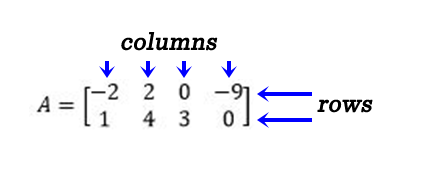
The size of a matrix is determined by the numbers of rows and columns the matrix has. The number of rows is always listed first and then the number of columns.
Matrix A is a 2 x 4 matrix (read: 2 by 4), because there are 2 rows and 4 columns.
Matrix B is a 3 x 1 matrix (written: B3×1), because there are 3 rows and 1 columns.
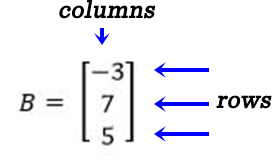
Each entry in a matrix is called an element.
II. Matrix Multiplication
Matrix multiplication is the most difficult matrix operation tested on the ACT. This is one of the rare instances where the use of a calculator may save you time on the ACT. If you choose to enter the matrices into your calculator and multiply, you may not be required to understand the instruction provided below.
Example 1
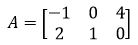
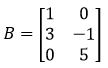
Find the product AB.
Carefully follow these three steps to multiply matrices.
Step 1: Determine if the matrices can be multiplied.
In order to multiply matrices, the number of columns of the matrix listed first must match the number of rows in the matrix listed second.
Matrix A is a 2 rows x 3 columns matrix: A2×3.
Matrix B is a 3 rows x 2 columns matrix: B3×2.
(A2×3)(B3×2) is defined, because the 3’s match! The matrices can be multiplied.
Step 2: Determine the size of the resulting matrix.
The “outside” values give the size of the resulting matrix. A is a 2 x 3 matrix, and B is a 3 x 2 matrix. The size of the resulting matrix is a 2 x 2.
In more technical terms, the resulting matrix has the same number of rows as the first matrix of the product — matrix A — and the same number of columns as the second matrix — matrix B.
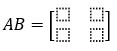
Now, we just have to find the missing elements!
Step 3: Distribute rows of the first matrix to columns of the second matrix.
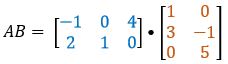
i) The first row of matrix A is distributed to the first column of matrix B.
(-1)(1) + (0)(3) + (4)(0) → -1
This is the first element of the resulting matrix.
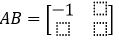
ii) The first row of matrix A is distributed to the second column of matrix B.
(-1)(0) + (0)(-1) + (4)(5) → 20
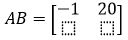
iii) To find the second row of AB, distribute the second row matrix A to the columns of matrix B.
(2)(1) + (1)(3) + (0)(0) → 5
(2)(0) + (1)(-1) + (0)(5) → -1
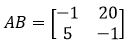
As you can see, multiplying matrices can be a tedious process.
Example 2
Let’s use the same two matrices from the previous example, but switch the order.
Find the product BA.
Carefully follow these three steps to multiply matrices.
Step 1: Determine if the matrices can be multiplied.
In order to multiply matrices, the number of columns of the matrix listed first must match the number of rows in the matrix listed second.
Matrix B is a 3 rows x 2 columns matrix: B3×2.
Matrix A is a 2 rows x 3 columns matrix: A2×3.
(B3×2)(A2×3) is defined, because the 2’s match! The matrices can be multiplied.
Step 2: Determine the size of the resulting matrix.
The “outside” values give the size of the resulting matrix. B is a 3 x 2 matrix, and A is a 2 x 3 matrix. The size of the resulting matrix is a 3 x 3.
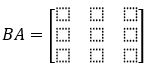
Now, we just have to find the missing elements!
Step 3: Distribute rows of the first matrix to columns of the second matrix.
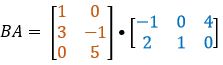
i) Distribute the first row of matrix B to the columns of matrix A to find the first row of BA.
(1)(-1) + (0)(2) → -1
(1)(0) + (0)(1) → 0
(1)(4) + (0)(0) → 4
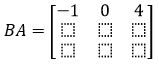
ii) Distribute the second row of matrix B to the columns of matrix A to find the second row of BA.
(3)(-1) + (-1)(2) → -5
(3)(0) + (-1)(1) → -1
(3)(4) + (-1)(0) → 12
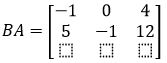
iii) Distribute the third row of matrix B to the columns of matrix A to find the third row of BA.
(0)(-1) + (5)(2) → 10
(0)(0) + (5)(1) → 5
(0)(4) + (5)(0) → 0
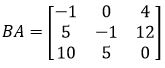
Important Note: The product AB (from Example 1) does not equal the product BA (from example 2). Matrix multiplication is not commutative.
Example 3
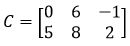
Find the product CD.

Step 1: Determine if the matrices can be multiplied.
In order to multiply matrices, the number of columns of the matrix listed first must match the number of rows in the matrix listed second.
Matrix C is a 2 rows x 3 columns matrix: C2×3.
Matrix D is a 2 rows x 2 columns matrix: D2×2.
The product (C2×3)( D2×2) is NOT defined, because C has 3 columns and D has only 2 rows. The matrices cannot be multiplied!