
Matrices: Addition, Scalar Multiplication, and Determinants – Outschool
Matrices Lesson
I. The Sizes of Matrices
The size of a matrix is determined by the numbers of rows and columns the matrix has. The number of rows is always listed first and then the number of columns.
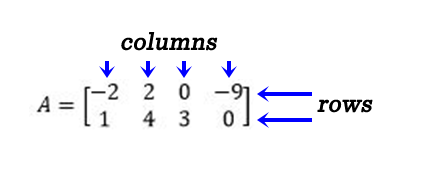
Matrix A is a 2 x 4 matrix (read: 2 by 4), because there are 2 rows and 4 columns.
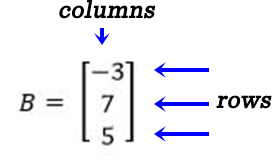
Matrix B is a 3 x 1 matrix (written: B3×1), because there are 3 rows and 1 columns.
Each entry in a matrix is called an element.
II. Matrix Addition
In order to add matrices, they must have the same dimensions.
To add matrices, add elements in corresponding positions.
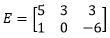
Three matrices are given below.
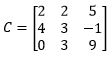
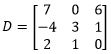
Example 1
Find C + D.
Add corresponding elements.
 +
+  →
→ 
Example 2
Find D + E.
+  is not defined because the matrices do not have the same dimensions. D is 3 x 3 matrix, and E is a 2 x 3 matrix.
III. Scalar Multiplication
To multiply a matrix by a scalar, multiply the scalar by each element in the matrix.
Example
Given F =  .
.
Find 4F.
4F → 4 → 
IV. The Determinant
Determinants can be computed for square matrices (matrices where the number of rows and columns are equal). Methods for calculating the determinant of a matrix vary based on the size of the matrix.
We have only seen the ACT ask for the determinants of 2 x 2 matrices.
Here’s how to compute the determinant of a 2 x 2 matrix:
Example
The determinant of matrix  equals ad – bc.
Find the determinant of matrix  .
.
Use the formula provided by multiplying the diagonals and subtracting:
The determinant of the matrix is (-2)(4) – (6)(1) → -14.