
ACT Science Final Quiz 3 – Outschool
ACT Science Final Quiz 3
You will be given 6 minutes to complete this 6-question science passage. Good luck!
Quiz Summary
0 of 6 Questions completed
Questions:
Information
You have already completed the quiz before. Hence you can not start it again.
Quiz is loading…
You must sign in or sign up to start the quiz.
You must first complete the following:
Results
Results
0 of 6 Questions answered correctly
Your time:
Time has elapsed
You have reached 0 of 0 point(s), (0)
Earned Point(s): 0 of 0, (0)
0 Essay(s) Pending (Possible Point(s): 0)
Categories
- Not categorized 0%
- 1
- 2
- 3
- 4
- 5
- 6
- Current
- Review / Skip
- Answered
- Correct
- Incorrect
-
Question 1 of 6
1. Question
Ansley moved into a new home with a large yard. She enjoyed growing daylilies and wanted to find the soil that best promoted their growth before she invested in soil for several flower beds.
Experiment 1
Ansley built a 4 feet by 4 feet raised garden with a uniform depth of 1 foot and divided it into four quadrants. Each of the four quadrants contained a different type of soil. She placed a daylily in each quadrant. Each of the daylilies were the same species and approximately 10 inches tall. Each quadrant received approximately the same amount of sunshine and water. She recorded the height, in inches, and total number of daylily buds at the end of each week for 3 weeks.

Experiment 2
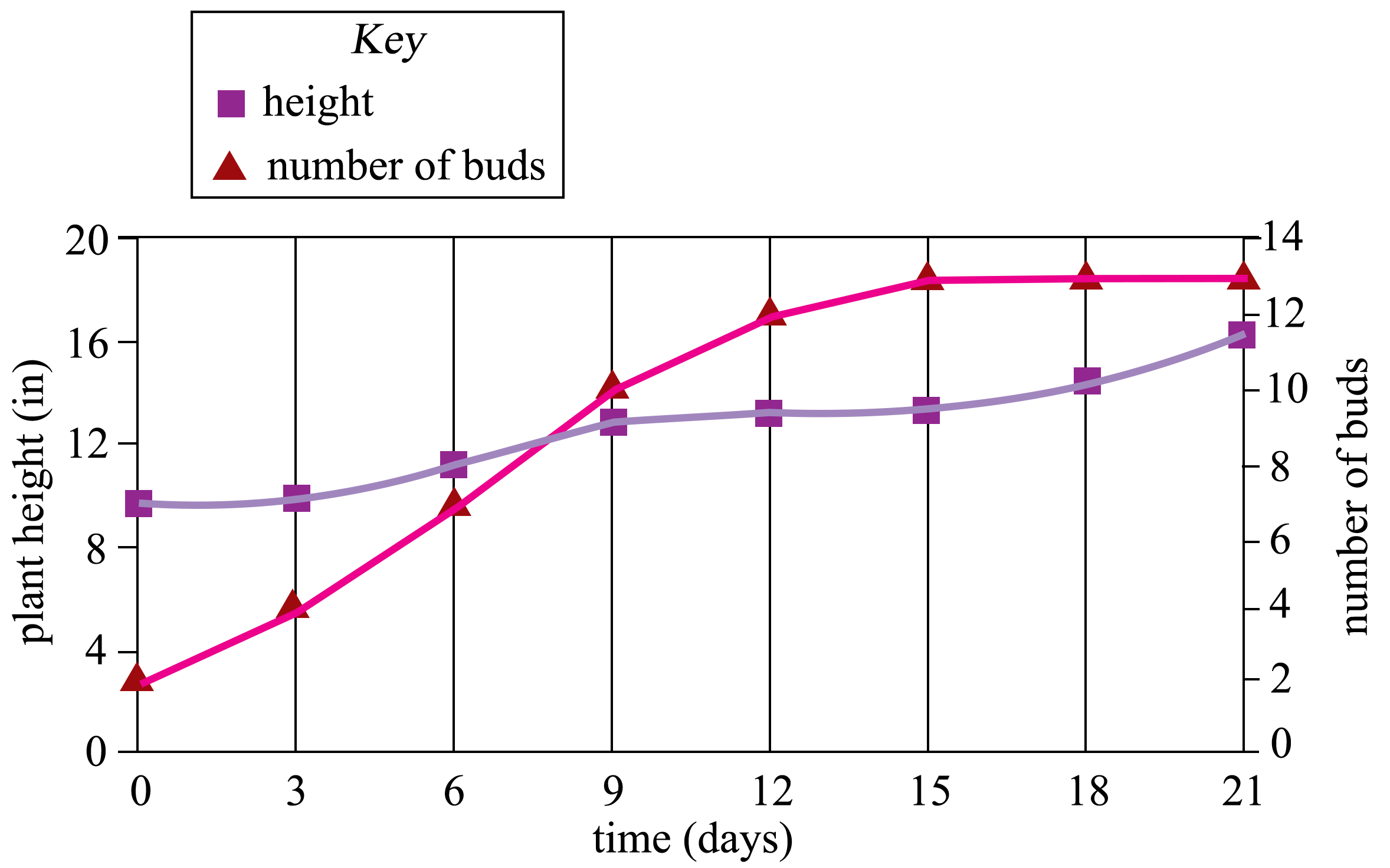
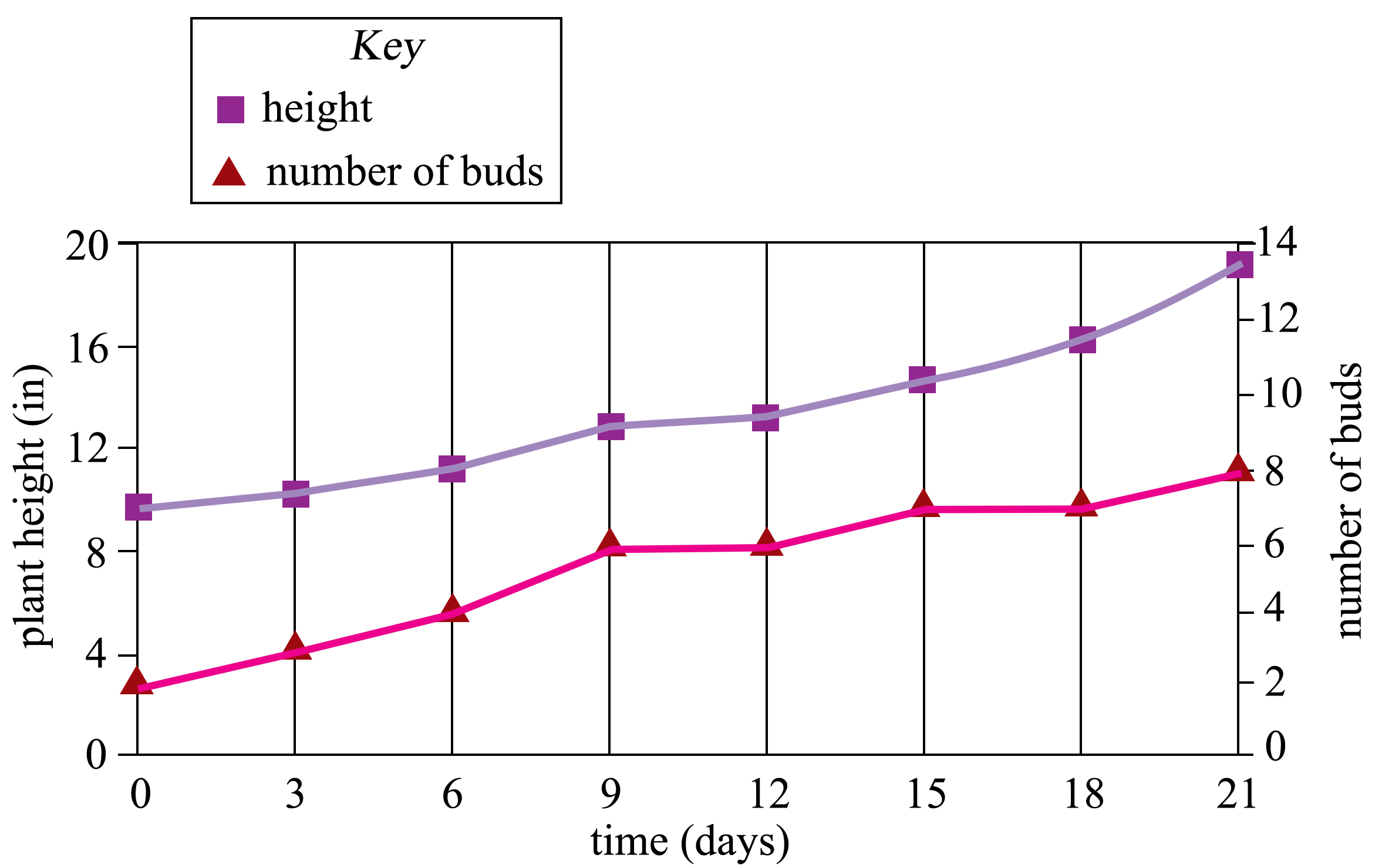
To measure the effects of watering, Ansley placed two more daylilies that were approximately the same size in two separate pots. Both pots had the same type of soil and received similar sunlight. The daylily in Pot A received a cup of water each day for three weeks. The daylily in Pot B received 7 cups of water on the first day of each week. The height and number of buds for each plant were recorded throughout the three weeks.
Daylily in Pot A results:
Daylily in Pot B results:
From the results of Experiment 1, the daylily in which quadrant gained the most height from the week 1 to week 3 measurements?
CorrectIncorrectHint
Question type: Reading Patterns in Tables
Step 1: Use the table from Experiment 1.
Step 2: Under Height, scan the Week 1 and Week 3 columns.
-
Question 2 of 6
2. Question
Ansley moved into a new home with a large yard. She enjoyed growing daylilies and wanted to find the soil that best promoted their growth before she invested in soil for several flower beds.
Experiment 1
Ansley built a 4 feet by 4 feet raised garden with a uniform depth of 1 foot and divided it into four quadrants. Each of the four quadrants contained a different type of soil. She placed a daylily in each quadrant. Each of the daylilies were the same species and approximately 10 inches tall. Each quadrant received approximately the same amount of sunshine and water. She recorded the height, in inches, and total number of daylily buds at the end of each week for 3 weeks.
Experiment 2
To measure the effects of watering, Ansley placed two more daylilies that were approximately the same size in two separate pots. Both pots had the same type of soil and received similar sunlight. The daylily in Pot A received a cup of water each day for three weeks. The daylily in Pot B received 7 cups of water on the first day of each week. The height and number of buds for each plant were recorded throughout the three weeks.
Daylily in Pot A results:
Daylily in Pot B results:
Based on the data from Experiment 1, which of the following graphs best represents the height of the daylily in Quadrant 1?
CorrectIncorrectHint
Question type: Matching Data with Graphs
In Quadrant 4, the daylily height was 11.0”, 12.8”, and 14.0”.
-
Question 3 of 6
3. Question
Ansley moved into a new home with a large yard. She enjoyed growing daylilies and wanted to find the soil that best promoted their growth before she invested in soil for several flower beds.
Experiment 1
Ansley built a 4 feet by 4 feet raised garden with a uniform depth of 1 foot and divided it into four quadrants. Each of the four quadrants contained a different type of soil. She placed a daylily in each quadrant. Each of the daylilies were the same species and approximately 10 inches tall. Each quadrant received approximately the same amount of sunshine and water. She recorded the height, in inches, and total number of daylily buds at the end of each week for 3 weeks.
Experiment 2
To measure the effects of watering, Ansley placed two more daylilies that were approximately the same size in two separate pots. Both pots had the same type of soil and received similar sunlight. The daylily in Pot A received a cup of water each day for three weeks. The daylily in Pot B received 7 cups of water on the first day of each week. The height and number of buds for each plant were recorded throughout the three weeks.
Daylily in Pot A results:
Daylily in Pot B results:
Which of the following changes to Experiment 1 would most strengthen the conclusions that could be drawn from those results?
CorrectIncorrectHint
Question type: Analyzing Experiments
Determine which change would help Ansley draw better conclusions.
-
Question 4 of 6
4. Question
Ansley moved into a new home with a large yard. She enjoyed growing daylilies and wanted to find the soil that best promoted their growth before she invested in soil for several flower beds.
Experiment 1
Ansley built a 4 feet by 4 feet raised garden with a uniform depth of 1 foot and divided it into four quadrants. Each of the four quadrants contained a different type of soil. She placed a daylily in each quadrant. Each of the daylilies were the same species and approximately 10 inches tall. Each quadrant received approximately the same amount of sunshine and water. She recorded the height, in inches, and total number of daylily buds at the end of each week for 3 weeks.
Experiment 2
To measure the effects of watering, Ansley placed two more daylilies that were approximately the same size in two separate pots. Both pots had the same type of soil and received similar sunlight. The daylily in Pot A received a cup of water each day for three weeks. The daylily in Pot B received 7 cups of water on the first day of each week. The height and number of buds for each plant were recorded throughout the three weeks.
Daylily in Pot A results:
Daylily in Pot B results:
In Experiment 2, all of the following were directly controlled by Ansley EXCEPT the:
CorrectIncorrectHint
Question type: Analyzing Experiments
The researcher does not control the dependent variable. The dependent variable is the variable that is measured to determine the effect of the independent variable. Researchers determine whether the dependent variable “depends” on the independent variable.
In Experiment 2, Ansley did not control the number of buds produced.
-
Question 5 of 6
5. Question
Ansley moved into a new home with a large yard. She enjoyed growing daylilies and wanted to find the soil that best promoted their growth before she invested in soil for several flower beds.
Experiment 1
Ansley built a 4 feet by 4 feet raised garden with a uniform depth of 1 foot and divided it into four quadrants. Each of the four quadrants contained a different type of soil. She placed a daylily in each quadrant. Each of the daylilies were the same species and approximately 10 inches tall. Each quadrant received approximately the same amount of sunshine and water. She recorded the height, in inches, and total number of daylily buds at the end of each week for 3 weeks.
Experiment 2
To measure the effects of watering, Ansley placed two more daylilies that were approximately the same size in two separate pots. Both pots had the same type of soil and received similar sunlight. The daylily in Pot A received a cup of water each day for three weeks. The daylily in Pot B received 7 cups of water on the first day of each week. The height and number of buds for each plant were recorded throughout the three weeks.
Daylily in Pot A results:
Daylily in Pot B results:
Eighteen days into Experiment 2, the height of the daylily in Pot B was closest to:
CorrectIncorrectHint
Question type: Multiple Y-Axes
Step 1: Identify the graph that contains Pot B results in Experiment 2.
Step 2: Use the key to determine that the purple squares represent height.
Step 3: Start at 18 days on the horizontal axis.
Step 4: Trace up to the purple square.
Step 5: Trace left to find the plant height.
-
Question 6 of 6
6. Question
Ansley moved into a new home with a large yard. She enjoyed growing daylilies and wanted to find the soil that best promoted their growth before she invested in soil for several flower beds.
Experiment 1
Ansley built a 4 feet by 4 feet raised garden with a uniform depth of 1 foot and divided it into four quadrants. Each of the four quadrants contained a different type of soil. She placed a daylily in each quadrant. Each of the daylilies were the same species and approximately 10 inches tall. Each quadrant received approximately the same amount of sunshine and water. She recorded the height, in inches, and total number of daylily buds at the end of each week for 3 weeks.
Experiment 2
To measure the effects of watering, Ansley placed two more daylilies that were approximately the same size in two separate pots. Both pots had the same type of soil and received similar sunlight. The daylily in Pot A received a cup of water each day for three weeks. The daylily in Pot B received 7 cups of water on the first day of each week. The height and number of buds for each plant were recorded throughout the three weeks.
Daylily in Pot A results:
Daylily in Pot B results:
Based on the results of Experiments 1 and 2, which of the following combinations would result in the most daylily growth?
CorrectIncorrectHint
Question type: Utilizing Multiple Data Sources
Eliminate choices A and B. The soil in Quadrant 4 produced the most growth.